


26 May 2026
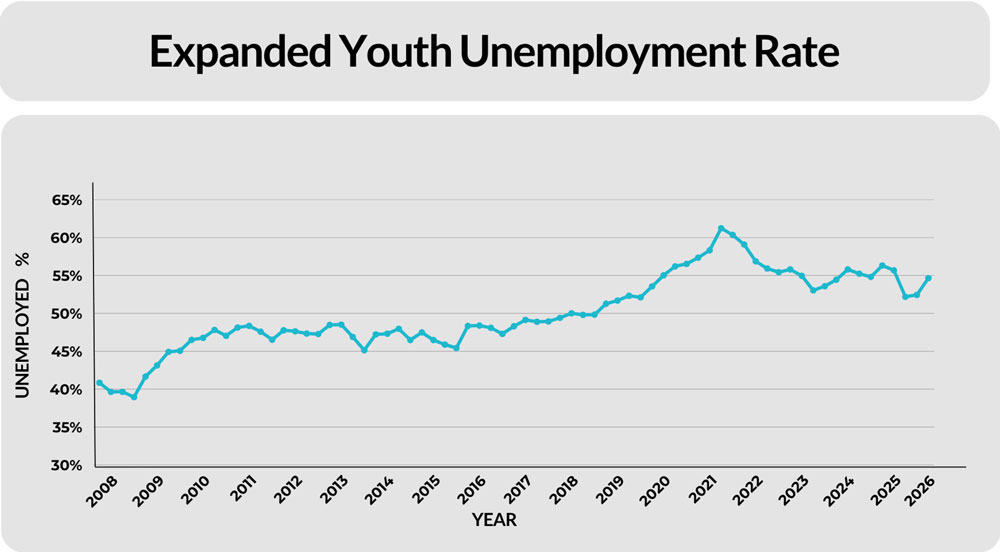
Fifty years after the student uprising that defined Youth Day on 16 June 1976, South Africa’s young people have secured their political freedom, but the struggle for economic inclusion continues. They face challenges on two fronts: the persistent systemic barriers of the past, and a world that is becoming increasingly complex and unpredictable. Current volatility in geopolitics and the resulting oil shocks are clouding the economic groundwork that must form the foundation of job growth. The latest Quarterly Labour Force Survey (QLFS) data reflects this climate of compounding challenges, showing that youth unemployment among those aged 18 to 35 has risen slightly to 54.65%, driven by seasonal dips, global events and the absence of large-scale Public Employment Programmes (PEPs).
But this should not distract us. Like climate data, employment data is multilayered. It reflects short-term weather, seasonal cycles, and long-term trends, and it is the latter that we must focus on to turn the tide.
First and foremost, growth signs persist, with the economy expected to grow by 1.6% in 2026, up from 1.4% in 2025. This steady momentum can be further strengthened through structural economic reforms, stabilised inflation, improved business and consumer confidence, and higher investment. Second, there is a growing consensus that youth employment is a national priority, driven collectively by a coalition of business and government stakeholders that is broader, more motivated and aligned than it has ever been. Third, and perhaps most critically, we have nationalised and scaled up the infrastructure that enables us to find, understand, and support formerly ‘unreachable’ young people into work: the SA Youth platform. This network has become a new ecosystem of opportunity that reaches more than 5.1 million young people and recorded over 2.3 million formal, self-employment and public employment opportunities since 2011.
The SA Youth platform has become a vital source of labour market insights, helping to guide national youth employment efforts. This is because the young people who join the network are disproportionately drawn from groups that remain underrepresented in the labour market due to systemic exclusion. For instance, two-thirds of young people in our network are women, while 72% are from educational quintiles 1-3 (no-fee paying schools), where school data is available. This high level of inclusion translates into improved employment outcomes for these groups, compared to the broader labour market: Women account for 69% of earning opportunities reported on SA Youth, compared to 42% of young women securing work in the labour market; and about 40% of SA Youth placements have been taken up by young people under the age of 25, compared to the national benchmark of 18%.
SA Youth achieves these outcomes because it is inclusive by design. The platform offers innovations like the downloadable CV that makes young people’s informal and unpaid work visible; transition mapping that improves visibility of labour‑market flows; and dynamic demand–supply matching, geolocation and labour‑market intelligence that drives system‑level efficiency. Together, these features are helping to shift hiring norms. Early evidence suggests that employers using inclusive signals, such as behavioural screeners, have seen an up to 50% increase in hires and a 5–6% increase in inclusion of young people without prior formal work experience.
There is equally positive evidence of impact on the demand side, found in sectors with high growth potential and enabled by ecosystem partners. In Global Business Services (GBS), the partnership between Business Process Enabling South Africa (BPESA), Department of Trade, Industry and Competition (dtic) and Harambee has resulted in the creation of 147,405 jobs since 2018. In the Tourism sector, direct employment increased by 28% between 2022 and 2024. For employers operating in these sectors, SA Youth has reduced hiring friction and enabled cost‑effective sourcing of strong candidates at scale, with hires made through SA Youth showing lower attrition and absenteeism than traditional hiring pools.
Beyond the formal economy, SA Youth has provided efficient, geo-located recruitment for PEPs, such as the Basic Education Employment Initiative (BEEI), whereby the platform enabled over 1.1 million young people to be hired across the five phases. These programmes build valuable skills and bridge young people into work.
Finally, we cannot meet the challenge of youth unemployment without also growing the scale, stability and attractiveness of self-employment, which in South Africa is particularly underpowered. SA Youth will support this effort too: 75,000 young people using the platform report self‑employed activities, and 24% of those earning do so through self‑employment, including via partner‑mediated pathways that yield higher income, retention and stability. The greatest impact, however, will come when there is a foundational shift from society’s bias for formal work, that constrains the playing field for youth entrepreneurs, to more openness towards informal and innovative opportunities.
The ‘weather’ of unemployment data notwithstanding, the evidence has never been stronger that to translate economic momentum into inclusive youth employment, we need labour market systems like SA Youth, and the ecosystem around it, operating at full scale and power. This means shifting from a mindset of intervention to a mindset of new norms:
A practical roadmap for each of these is our focus in this edition of Breaking Barriers.

Growth is necessary. But what growth South Africa has experienced over the past 17 years has translated disproportionately into jobs for older workers and a decline in the youth share of jobs. This weak correlation between growth and youth employment levels must be strengthened if we are to avoid a generation of young people being left behind.
To achieve this, we must shift hiring norms so that every private sector employer has an inclination towards hiring young people. Analysis of our latest income survey of 3,167 young people reveals that every time a young person lands a structured, decent work experience, there is a lasting economic dividend – individuals are 10 percentage points more likely to remain in the labour market and 10 percentage points more likely to secure further wage employment. Support is vital: those who have access to mentorship and coaching develop the foundational work-readiness skills needed for economic mobility.
For many young people, that first work experience can be most readily found in the retail sector. On the SA Youth platform, retail accounts for the largest share of formal employment absorption: of 200,000 formal sector placements reported, 40% are in retail. It is one of the most important labour market entry points and proving grounds for young people, which is why we need the retail sector to become youth-powered by default. Retail can, however, also be subject to seasonal fluctuations, as seen in the QLFS recorded loss of 59,865 youth jobs this past quarter. But this is not inevitable. McDonald’s is one example of a retail employer that is bucking the sector’s trend of declining share of youth jobs by prioritising the inclusion of youth. In partnership with Culture, Arts, Tourism, Hospitality and Sport Sector Education and Training Authority (CATHSSETA), McDonald’s is creating over 2,000 learnerships over the next 12 months, building off a base of successful learnerships last year, with the intention to absorb into permanent employment. Critical to the success of McDonald’s’ learnership model is its intensive onboarding process and ongoing mentorship.
The sector’s size makes it a key focus for action that shifts hiring norms that favour older workers over youth. Currently, the labour market reads the signal of ‘retail experience’ (i.e. time spent in similar jobs as detailed on a CV) more easily than signals of ‘potential’ (transferable skills gained through unpaid work, self-employment, or public employment). The SA Youth CV, launched last year on the platform, helps overcome this by making these signals of potential easy for the young person to capture and for the employer to interpret. With more than 8,300 downloads to date, over 170 employers have used the CV, including large retail restaurant chains like Nando’s and Steers.
For employers like these, the SA Youth CV reduces over‑reliance on matric results and paid work experience, expanding access to capable candidates who may otherwise be overlooked. SA Youth data confirms the value of utilising inclusive labour market signals like the behavioural screener in complementing traditional employment proxies. Expanding the use of the SA Youth CV is an immediate way retailers can tap into a high-potential young talent pool without compromising on hiring quality.
Retail has the largest capacity to hire young people, but other youth-accessible sectors are growing faster and are thus an equally important focus for shaping norms. GBS continues to grow as an industry and as an entry point for young people into good, formal economy employment. With 131,474 jobs created and secured by youth since 2018 – 26,346 of them in 2025 alone – this is a 28% increase from 2024 and the highest number recorded in any financial year. In the Tourism sector, direct jobs grew from 745,066 in 2022 to 953,981 in 2024. This accounted for 5.7% of all employment, with historical data suggesting that youth take up at least 40% of tourism opportunities. We estimate that going forward, this proportion could grow to half of all new jobs created. This growth trend is set to persist with over 2.9 million visitor arrivals from January to March 2026 – a 12.5% increase from the same period last year.
We must throw our collective weight behind growth strategies that position youth employment as a core enabler. This includes aligning tax credits, subsidies and compliance instruments (including B‑BBEE) around inclusive hiring and skills investment; removing red tape that inhibits growth (as with the Electronic Travel Authorisation visa reforms that are helping fuel tourism); and supporting scalable, service‑led and labour‑absorbing sectors through coordinated industrial and sector policy (as with GBS).
But employers do not need to wait for these policy reforms to act. As the 2.3 million opportunities already secured on SA Youth show, many interventions are proven and wholly within the purview of employers’ talent strategies today. They can adopt alternative ways of hiring that assess potential, not just experience; embrace employer-led and co-financed training models that improve hiring success; and provide stable contracts and targeted support, such as transport stipends to increase retention.

Conventional wisdom and even research suggest that, given the scale and persistence of the unemployment crisis, young people should be disengaged and permanently discouraged. But in South Africa, they are not.
The research network Afrobarometer conducts surveys across several African countries on issues ranging from economic outlook to social cohesion and perceptions of democracy. In their latest survey, data shows that despite young people in South Africa being objectively more excluded from the labour market and facing higher unemployment, they are more hopeful than older adults about both their living conditions and the state of the country. Forty-one percent of young people reported feeling fairly good or good about their present living conditions, compared to 35% of older adults. Harambee’s income survey data of 6,345 individuals reinforces these findings. It also suggests these experiences vary by gender, age, and employment status, with employed youth consistently more likely to report higher levels of hope, confidence, and optimism about their life direction than those who are unemployed.
SA Youth does not just hold a mirror up to young people’s optimism; its contact centre approach actually helps fuel and direct it. Voice and WhatsApp journeys are based on research showing that hope is not perceived as a feeling but rather a cognitive process made up of goals (jobs), pathways (SA Youth infrastructure), and agency (youth themselves) [Snyder, 2002]. This has informed contact centre engagements, whereby young people are equipped to identify obstacles and take one concrete action in real time. The result is that across channels, young people don’t just report hope, they consistently choose to act on it in small, repeated ways, even under real structural constraints. This is what climate activists call ‘grounded hope’.
This grounded hope is a tremendous asset, but if we don’t give young people a bridge to concrete prospects, it will be squandered. In our economy, this vital bridging role is played by PEPs, reflected in their sustained scale of applications. In the lead-up to Phase V of the BEEI in 2025, over 600,000 young people joined SA Youth in anticipation, and 1.9 million applied once the opportunity was live. This ‘anticipatory engagement’ by young people rises when there is the prospect of jobs within their reach.
But this also works conversely, seen in the latest QLFS data, which showed an uptick in discouraged work-seekers. In Q1 2026, the 199,724 young people who were engaged in Phase V of the BEEI during the previous quarter have transitioned out of the programme. This corresponds to the overall 255,000 fewer young people employed and the proportional drop in community and social service jobs. The numbers from large-scale PEPs are reflected in national statistics, and the absence of such interventions highly correlates with youth employment figures. This linkage highlights the role of such programmes as critical shock absorbers to youth engagement in the labour market. Our research shows that the more work experience a young person has in PEPs or self-employment, the more likely they are to eventually report a formal sector job. This is where the value of the SA Youth pathway management model is seen most clearly: the network is not designed simply to match young people to jobs, but to actively help them reframe the totality of their experience and skills over time.
This is especially important for those involved in unpaid and voluntary work, which would otherwise be invisible to employers. Millions of young people are working invisibly in South Africa’s care economy, 84% of them women. Care work is both a necessary enabler to the functioning of South Africa’s economy and a compelling source of new job creation, yet 65% of care workers are unpaid. Where women’s care work is paid, it is often informal and/or underpaid and precarious, seen most clearly in domestic work and early childhood development (ECD). And yet, the daily tasks of care work, whether paid or unpaid, build valuable and transferable skills that our labour market has historically failed to recognise or capture. These roles are not passive: they involve responsibility, skill-building, and service to others. The data shows young people actively seeking ways to stay productive, gain experience, and contribute socially while waiting for paid opportunities.
The SA Youth CV helps young people put a professional lens on their efforts. To date, the CV has been downloaded by 782,167 unique young people, of whom 33% have gone on to make meaningful improvements to their profiles such as adding qualifications or experience, or completing assessments. SA Youth has also recorded a 56% increase in the number of experiences reported on the same day the CV is downloaded. This suggests that the tool is motivating higher work-seeking engagement by young people, as well as capturing information to improve their match to jobs on the platform. A new feature allows young people to add up to five skills to each unpaid or self‑employment experience on their CV, helping them recognise the value of unpaid work as a legitimate pathway into the formal labour market. It empowers young people to identify and articulate the skills they have gained, build confidence to apply for roles they may not otherwise consider, and speak more confidently about their experience in interviews. With 84% of newly created unpaid or self-employed experiences recorded having at least 1 skill selected, the feature also showcases high engagement by youth.
The SA Youth platform is able to deliver this impact at a lower cost to young people, three-quarters of whose average work-seeking costs are made up of internet data and transport. It also shortens their search: those reporting secured opportunities generally do so within the first year, with most formal sector jobs reported within a young person’s first 6 months on the platform. In this way, SA Youth offers a direct cost-saving of up to R448 million across the estimated 1,015,419 unique active work-seekers it supports each year.
Unlike many economies that have rising numbers of youth not in education, employment or training (NEET), the issue is not whether young people are ready, willing and able to contribute to growth, but whether our systems — hiring practices, skills pathways, financing models and risk assumptions — allow them to.

Even if the formal economy grows at the most optimistic rate forecasted, and employers across industries make bold shifts towards inclusive hiring practices for youth, it will be insufficient to absorb the number of young people wanting to work. Amidst arguments that much of the piece work South Africans participate in is not recorded, or that employment definitions in official labour force statistics are too rigid, the fact remains: unemployment is unacceptably high, and a large increase in self-employment must form part of the solution.
South Africa’s self-employment activation challenge is not only, or even chiefly, about motivation: as we’ve seen, young people are engaging and ready to work. Nor can it be explained by a simple lack of skills or information: even programmes that are well “scaffolded” with a mix of access, coaching and capital encounter a pattern of strong initial interest followed by low uptake, poor retention, and limited sustained earning. More fundamentally, South Africa’s informal economy reflects an environment that inhibits the kind of measured risk-taking that is the lifeblood of entrepreneurialism. This aversion to risk operates at three levels: a society-wide mindset and formality bias; a self-employment ecosystem poorly set up to facilitate entrepreneurial value chains; and internalised risk aversion on the part of young people themselves. We must tackle this at all three levels.
First, how we think about risk in the context of our economy must fundamentally shift. An entrenched formality bias at one end of the economic spectrum gives rise to a regulatory environment that throws up barriers to earning activity in the ‘messy middle’. This highlights the importance of linking income support to pathways into work, to avoid reinforcing long-term dependence. The big, formal sector company and the big social grant programme share the feature of being known quantities, versus the perceived uncertainty and risk of everything in between. This dynamic plays out day-to-day when we see, for example, a big business towing a trailer truck into a township to engage consumers there, but we do not see the reverse: large numbers of township-based entrepreneurs taking their services and wares into the wealthier suburban consumer markets. The principle of loss aversion is at play: we price the perceived risk of a vendor on the street corner higher than the actual risk factor of removing people’s economic agency so completely that they bring much greater problems to suburban gates.
A primary argument for regulation is to remove risk for society. But there comes a point when this risk mindset becomes so institutionalised that it paralyses the people it is meant to protect. In an environment that regulates too rigidly, the lifeblood of entrepreneurialism simply dries up. Instead, we need to look for trickles of entrepreneurial activity and—rather than letting them silt up—direct those channels to turn a trickle into a river and connect it into the wider flows of labour and capital. This is an economy optimised not for formality but for flow, able to spot flickers of dynamism and move resources to those creating it (in the words of economist David McWilliams, ‘those who make the economy dance‘).
To help bring about this shift, many distinct but interconnected actors must take coordinated action across the ecosystem. The value of market intermediaries is not just to de-risk but to lubricate the system, connecting microenterprises with viable business models, demand aggregation, and supply chains. Financiers provide context-relevant financing instruments such as start-up capital, asset financing, and working capital to get ventures off the ground, while capacity builders equip entrepreneurs with essential trade-related and business skills. On the youth development side, youth intermediaries must explicitly work to make self-employment aspirational and accessible so that the social grant is no longer seen as the only option, partnering with motivators and guides who can provide ongoing coaching for resilience and success.
There are promising examples of this kind of ecosystem coordination in action: acting as both capacity builder and financier, Umuzi‘s Be Green programme equips existing and start-up Green Entrepreneurs with business and design thinking skills, mentorship and microfinance. To date, Umuzi have disbursed approximately R8 million across 100 ventures, and will reach over 3,000 young South Africans through a three-year scale-up that is currently underway in partnership with Jobs Fund and UNICEF. Elsewhere, Rhiza Babuyile plays multiple roles within their holistic community development model focused on healthcare, education and livelihoods. Their ‘agripreneurship’ social enterprise, Munching Mongoose, lets young farmers access land, incubation, and a guaranteed market, allowing them to “fail safely” while generating income. By directly linking township producers to suburban consumers, the model shifts money into township economies and removes structural barriers to youth self‑employment.
The final front in a systemic approach to the self-employment challenge: increasing young people’s confidence to take the ‘smart risks’ that entrepreneurship requires. Research shows that extreme risk aversion arises as a response to the neurobiological and behavioural effects of living under chronic scarcity and structural disadvantage. In these conditions, people often develop survival-adaptive but opportunity-limiting patterns of decision-making such as heightened threat sensitivity, elevated risk aversion and a diminished capacity for sustained, goal-directed planning. These are not character flaws; they are predictable, well-documented behaviours in response to adverse environments, observed across disciplines and geographies.
These behaviours are addressable. Over a decade of working with young work-seekers, Harambee and our partners have been able to pinpoint the behavioural and systemic barriers that need to be broken in order for young people to be ‘socialised’ for jobs. Now we need to do the same for self-employment, recognising that socialisation for entrepreneurship looks different from socialisation for employment. We must pinpoint the behavioural, platform, and environmental frictions that shape their decision-making, and tackle them in a coordinated way, designing interventions that overcome the perceived risk of losing current income, time, or social standing that may otherwise outweigh the appeal of a new opportunity, even when that opportunity is financially attractive.
It is crucial that we make these shifts now, when opportunities for new kinds of entrepreneurship, aided by AI and digital platforms, are emerging across growth sectors such as Tourism. Young people, with their strong digital and cultural skills, are well-positioned to innovate new services and products, and new ways of transacting with the influx of visitors. Facilitating digital connectivity for all our young people is important, but not enough: a wholesale shift in mindset, ecosystem and support is urgently needed.
Geopolitical volatility and economic upheaval will continue to shape the headwinds facing South Africa’s young work seekers, creating winners and losers with every cycle. The ‘weather’ will change, but the long-term trends are clear, as are the solutions. Sustained commitment across society is needed to support young people into early careers, public employment and self-employment. Fifty years ago, young people broke down literal barriers to fight for our political freedoms. Many of those people are now in positions of authority and influence across the nation, whether in business, government, education or civil society. Many are already taking action, some as leading members of the coalition alongside Harambee. We call on them to break the remaining barriers that will unlock economic inclusion for the generation that follows.
In Q1 2026, the official unemployment rate increased by 1.3 percentage points to 32.7%, and the expanded youth unemployment rate for those aged 18-35 years reached 54.65%, increasing by 2.22 percentage points from 52.43% in Q4 2025. Across the labour market, 345,000 fewer people were employed, of whom a 74% share was made up by young people. The largest decrease was seen within the formal economy. Discouraged job-seekers dominate the potential labour force – made up of individuals who could and want to work but are unavailable or choosing not to – accounting for 80,2% (3.9 million).
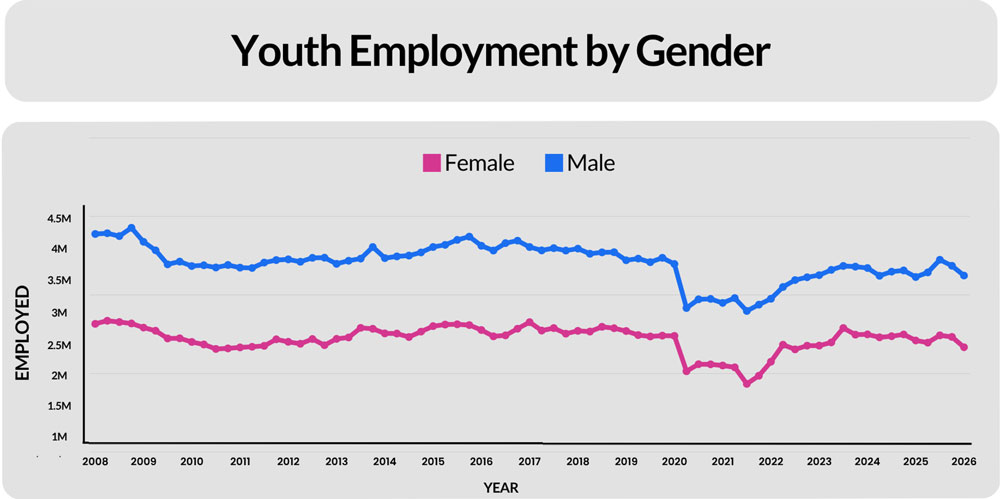
Amongst the 255,000 fewer young people employed, this decline was evenly split between men and women. Specific sectors that were impacted include Retail (59,865 fewer youth jobs), Construction (116,000 fewer youth jobs) and Community and Social Services (141,800 fewer youth jobs). Agriculture, Manufacturing, and Finance and Business Services saw an increase in jobs, but by marginal amounts. Youth classified as discouraged workers also increased from 10.75% to 11.33%, while the total figures of NEET youth increased to 9.2 million. The point-in-time nature of the QLFS may not completely capture the zig-zag and short-term nature of work in South Africa, missing out some people who move in and out of the labour market. That being said, as a metric, it is consistent, statistically validated, using academically recognised methods that continue to highlight the dire situation of youth unemployment in South Africa.
These lower employment figures reflect an economy buffeted by strong local and global winds. South Africa historically has lower employment figures in the first quarter of the year, as the seasonal boost of year-end tapers off. Culminated with global trends – the war in the Middle East and rising petrol prices – the pinch is being felt by consumers and businesses alike, translating into constrained economic activity. The year also commenced without a formidable public employment programme (e.g. BEEI or National Youth Service), which has previously shown to be an effective shock absorber, providing a safety net for young people’s engagement in the labour market.




Harambee in the News
04 Sep 2026
Harambee in the News: A snapshot of where Harambee Youth Employment Accelerator was featured in the media each month, reflecting ongoing conversations around youth employment, inclusive hiring, and the partnerships helping to connect young people to meaningful work opportunities across South Africa.

Harambee in the News
01 Jun 2026
Harambee in the News: A snapshot of where Harambee Youth Employment Accelerator was featured in the media each month, reflecting ongoing conversations around youth employment, inclusive hiring, and the partnerships helping to connect young people to meaningful work opportunities across South Africa.
 Stay Connected