

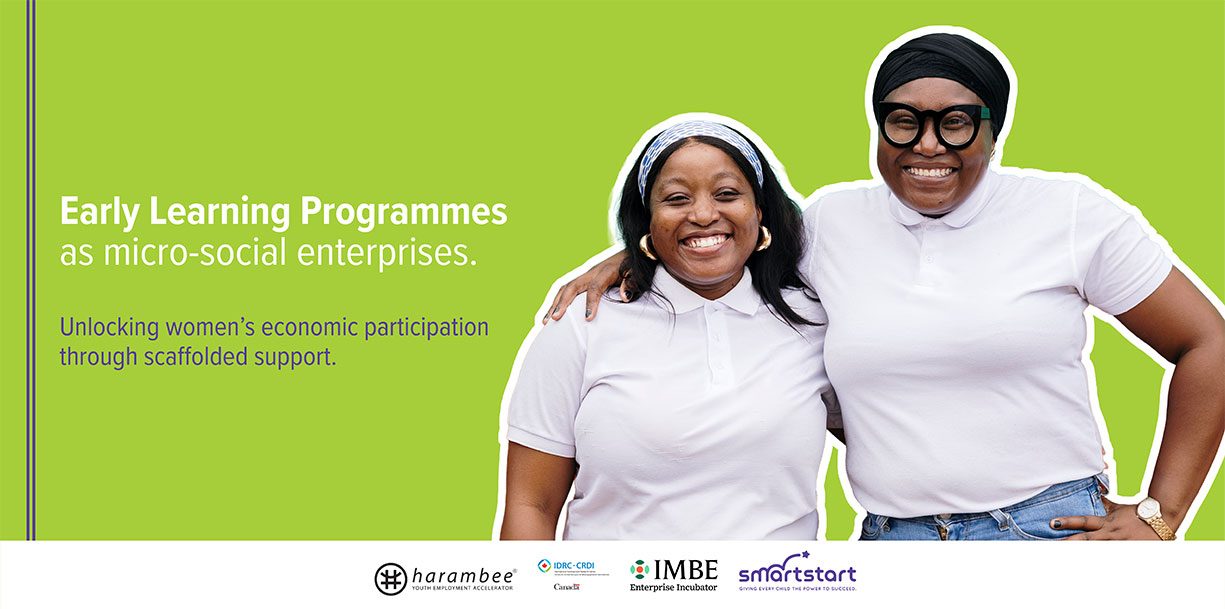
As Women’s Month draws to a close, there is a familiar temptation to celebrate women’s resilience and achievements. All of those things are worth recognising; however, recognition on its own does very little to change the conditions under which women live and work.
This is particularly true in the care economy, where so much of the essential work women do remains poorly recognised and undervalued. Early learning is one such case. Across South Africa, thousands of women run early learning programmes (ELPs) from homes and community spaces. These programmes give young children opportunities to learn and develop, create livelihoods for the women who provide them, and make it possible for other caregivers, particularly women, to participate in work or study. In low-income communities, they are part of the social and economic infrastructure that keeps families and local economies going.
Yet the economics remain precarious. Research notes that programme fees in lower-income communities average between R218 and R313 per month, while nearly 90% of ELP staff earn below the national minimum wage [ECD Census, 2021; Thrive by Five, 2022]. And although the existing government subsidy provides some relief, the amount is insufficient to cover all costs. Moreover, provider costs, household poverty and regulatory requirements all reinforce one another. The result is that ELPs serving low-income communities face infrastructure and compliance costs they cannot absorb, while the families they serve cannot pay higher fees [Ilifa Labantwana, 2026].
The maths simply does not work, if we expect parent fees and the ingenuity of individual women to carry the system.
This is where scaffolded support matters. SmartStart and Harambee’s paper, developed for the 2025 G20 Conference on Financial Inclusion and Women’s Empowerment, argues that expanding early learning access requires an environment in which more women can establish and sustain quality programmes over time. This scaffolded support can include programme start-up assistance, access to suitable venues and infrastructure, help navigating compliance and registration processes, training and coaching, business support, quality assurance, and pathways into public financing.
Many organisations in the sector already provide different forms of scaffolded support. SmartStart’s delivery platform helps practitioners with recruitment and programme set-up, training, coaching, quality support and navigating registration. IMBE’s 12-month Accelerator Programme offers targeted business management support to ELPs through the development of financial and business acumen, and assistive technology. Public Employment Programmes (PEPs) have also shown how temporary income support can reduce some of the risk involved in entering this ecosystem. These efforts are important but also cannot compensate for gaps in the wider system.
South Africa has committed to universal access to quality early learning by 2030. Realising this ambition requires government, civil society and other partners to create the conditions in which early learning provision can be scaled and sustained. Recent increases in public investment, the Mass Registration Drive and wider regulatory changes are important steps towards this, but significant barriers remain in reaching the most excluded children in communities.
For early learning to become a meaningful route into livelihoods for women and a foundation for children’s development, the answer cannot be to tell women to become more resilient, entrepreneurial or financially savvy. Many already are. The question is what government, civil society and other actors put around them so that their work can become sustainable.
That means financing that reflects what quality provision actually costs and supporting women from the point at which they are trying to establish programmes, through to the period before they can access the ECD subsidy and beyond. It means investing in infrastructure, training and the wider support systems that make quality provision possible at scale. It also means finding better ways for government and non-state actors to combine their different capabilities, rather than expecting either providers or government to do everything alone.
Ultimately, recognising women’s contribution must mean more than celebrating what they manage to achieve despite difficult conditions. It requires that the conditions be changed so that the work women are already doing can offer a viable livelihood and enable South Africa to realise its commitment to quality early learning for every child.

Harambee in the News
01 Jun 2026
Harambee in the News: A snapshot of where Harambee Youth Employment Accelerator was featured in the media each month, reflecting ongoing conversations around youth employment, inclusive hiring, and the partnerships helping to connect young people to meaningful work opportunities across South Africa.
Harambee in the News
18 Feb 2025
Harambee in the News
21 Nov 2024
 Stay Connected