


Breaking Barriers
12 Aug 2026
Every August, in celebration of Women’s Day, we take a gender lens to the analysis of South Africa’s youth employment challenge. At the highest level, the data paints a superficial picture of stasis: women continue to lag men in overall employment, with the gender gap between male and female youth unemployment narrowing by a mere 2 percentage points over the past 18 years. On this view, women are persistently less employed and are neither losing nor gaining much ground over time.
At closer inspection, however, we see some shifts with women gaining greater shares of employment in certain areas of the economy, while losing in others. Looking at where, why, and what else is happening in those sectors yields insights that can benefit all those facing barriers to work. This is because women are ‘employment bellwethers’ – experiencing greater impact from the same economic shocks (like COVID-19) and structural barriers (like safety, high work-seeking costs, educational disadvantage) that affect all unemployed youth. Small or big shifts in their employment rates can signal wider labour market problems brewing.
Where employment interventions are in place to help women overcome these barriers, in many cases we see the kind of growth and productivity that benefits everyone. This is similar to the ‘curb cut effect’, in which the design of a system or environment intended to eliminate a barrier for one group (e.g. a ramp for persons with disabilities) also benefits a much wider population.
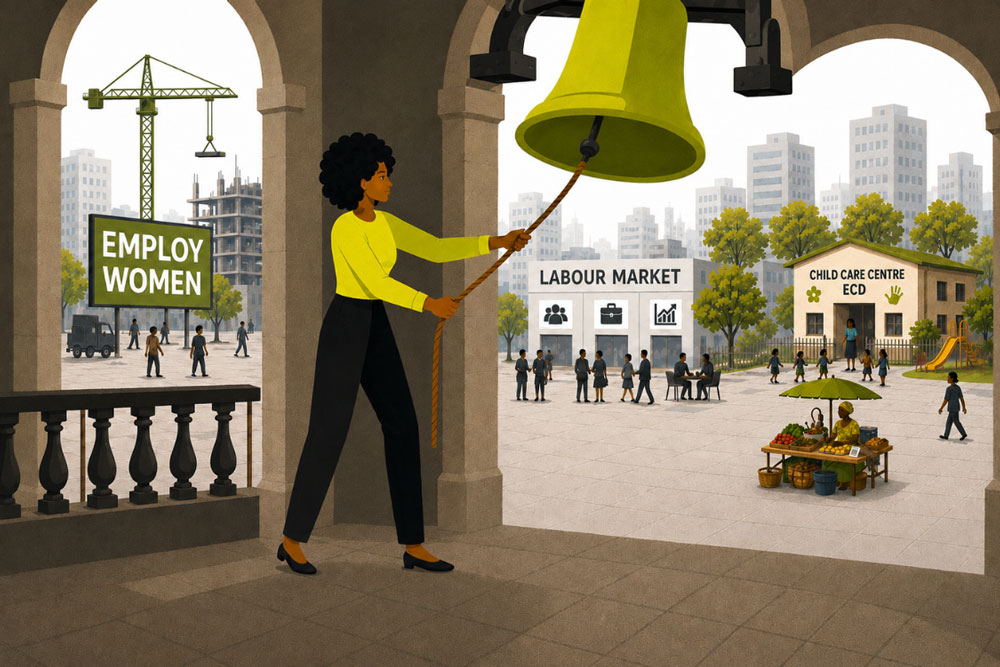
Breaking these barriers individually is important. But understanding how they interact, and tackling them in concert, is even more important. We call this ‘ecosystem coordination’. Caregiving is one area where women are both drivers and beneficiaries. Many data sources show that women shoulder by far the largest responsibility of care, much of it unpaid or underpaid. This care provision supports the entire economy but often blocks women from working to the extent they want. As a result, women have historically worked more in sectors and roles with less permanence and formal training – for instance, low-paid service roles, or precarious self-employment activities. Promising new models in care sectors like Early Childhood Development (ECD) address the interplay between proximity to work, flexibility, and job quality, making the system work better for women who want to work. This generates good jobs for professional caregivers while unlocking economic participation for women in other sectors. Viewed through this lens, the care economy has the potential to become a powerful economic engine.
Economic modelling suggests that in the next four years, the biggest potential reductions in unemployment – up to 20% – will come from the large-scale coordination of proven interventions and structural reforms across interlinked ecosystems. As South Africa’s entry-level employment mix shifts towards services-based roles, women have an opportunity to build on their skills and find an anchor in decent, stable work.
The Global Business Services (GBS) sector has shown what is possible when coordination is the goal of a sector’s growth plan, and not an afterthought: data shows that women are securing jobs in GBS and driving growth at much higher rates than other industries. The creation of blueprints for other sectors, including care, is gathering momentum, and women are key players across many of these efforts, fulfilling roles ranging from leaders to advocates to entrepreneurs to workers. Their experiences teach us how to design ecosystems for resilience. And in a volatile and disrupted world of work, that will serve us all.
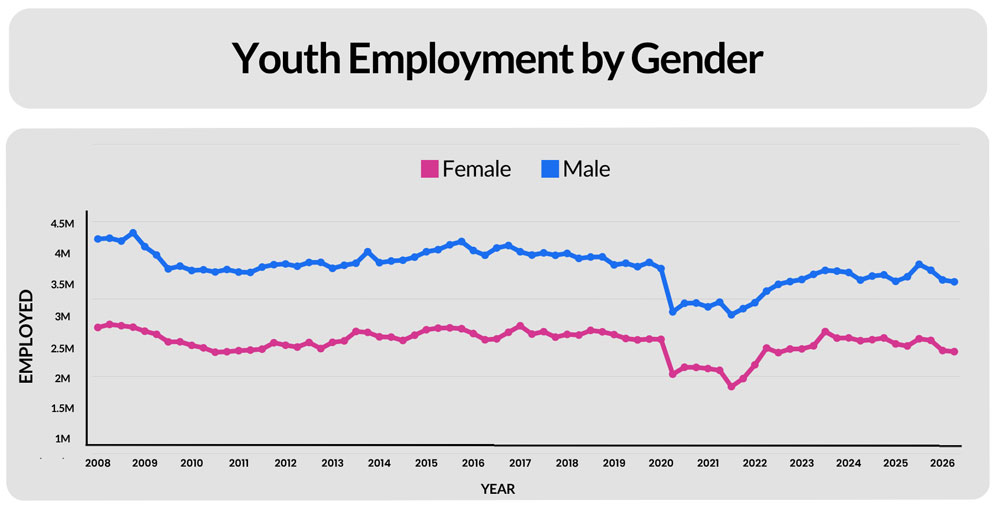
Women’s losses in the labour market often signal wider economic challenges. This effect was at its most painfully apparent during the COVID-19 pandemic: Women accounted for roughly two million or around two-thirds of all jobs lost and as employment gradually recovered, they experienced a slower and more uneven return to work. Women felt the shock first, deepest and longest. The gap persists. Latest QLFS data reflects that young women’s employment rates remain approximately 10 percentage points lower than men’s. When we analyse employment trends from Q1 2008 to Q1 2026, we see that the number of young women employed has fallen by 11% (roughly 298,000 jobs lost over the last 18 years), reaching a broad unemployment rate of 60%. Over the same period, young men’s employment fell by 14% but from a higher base, reaching a broad unemployment rate of 50% today.
The important question is: why? We know from women’s applications to public employment programmes that lack of desire to work is not a factor. By 28 July 2026, Phase V of the National Youth Service had attracted more than 1.23 million applications, of which women accounted for about 79%. Instead, their lower employment rates suggest that women run into higher, harder versions of the systemic barriers that drive economic exclusion. These are the same barriers that affect excluded youth more broadly: educational inequality, no or low experience, work-seeking costs, safety and access concerns. Analysing why, where, and how women experience employment losses shines a light on the deepest fault lines within the labour market that inhibit participation and drive precarity overall. Conversely, when female economic inclusion rises, it acts as a leading indicator of overall national productivity and inclusive growth. Thus, women’s experiences, positive and negative, in the labour market offer clues as to which parts of the system we must fix for the greatest potential impact.
While the COVID-19 pandemic was cataclysmic for women’s employment, the collapse happened along fault lines that were already there. Unequal care responsibility was a major factor. Almost all Child Support Grants (96%) go to women, highlighting the extreme extent to which women carry the burden of childcare in South Africa. Most care work (52%) in South Africa is unpaid, with women spending approximately 3.8 hours daily versus 1.6 for men on unpaid care (Time Use Survey, 2010). This shapes access to economic opportunity: of the 2.4 million people outside the workforce due to household responsibilities, 88.2% are women (QLFS Q1, 2025). Women also do the majority of paid care in South Africa. This sector is characterised by informality and pay below the minimum wage, leaving everyone employed within it with no financial cushion and no protection when personal or macro-economic shocks happen. This matters because it is a huge employment sector, encompassing domestic work, ECD, home-based care and community health work. The challenge to be overcome is professionalising roles in the sector at scale while keeping the pathways into it broad. A care sector characterised by fair pay and decent working conditions would drive inclusive and resilient employment growth and pay economic dividends more broadly.
Women’s experience in the informal economy more broadly is also instructive. Despite making up nearly three-quarters of all self-employed placements reported by participants on the SA Youth platform, women are more likely to be in a narrower set of activities, such as hair and beauty, childcare and selling goods and food, that are the lowest paying and least valued. At an income of about R514 per week, selling food generates the lowest earnings of all self-employment activities captured. This pattern matters because self-employment is an increasingly important area of focus for youth employment efforts and is already creating income for millions of young people. Raising the quality of the work and earnings from all forms of self-employment will benefit all young people, not just women.
Formalisation is not a complete answer. Women employed in the formal sector are less likely to reach top management roles, and earn less than men, with a pay gap of between 23% and 35% (versus a global average of 20%). However, there are signs of positive shifts in women’s engagement in the labour force, particularly evidenced in upskilling. QLFS data shows that 55% of young professionals are female, compared to only 45% in 2008 and the proportion of young female managers has also increased slightly from 31% to 35%. Occupations where there has been an increase of young women employed include professionals (23%), service workers/shop/market sales workers (10%), and legislators, senior officials and managers (2%).
Furthermore, there are glimmers of progress in industries where young women’s employment has steadily expanded. Since 2008, employment among young women has increased by 16% in business services and 30% in community services, outpacing growth among young men (4% and 7% respectively) and increasing women’s representation by 3 to 5 percentage points. Even traditionally male-dominated industries are starting to change. In mining and quarrying, young women’s employment grew by 79% from a low base of approximately 19,000 workers in 2008, with gains across both manual and higher-skilled occupations. While women remain underrepresented in the sector, this progress suggests that deliberate efforts to open traditionally male-dominated sectors, supported by industry commitments and policy instruments such as the Mining Charter and BBBEE frameworks, can create new pathways into occupations that were once largely out of reach for young women.
The areas in the economy where women are closing the gap due to targeted interventions are seeing high levels of dynamism and growth overall. This is an example of the ‘curb cut effect’ which can have positive impacts for the labour market overall. Thus, women’s experiences offer clues as to where to act.
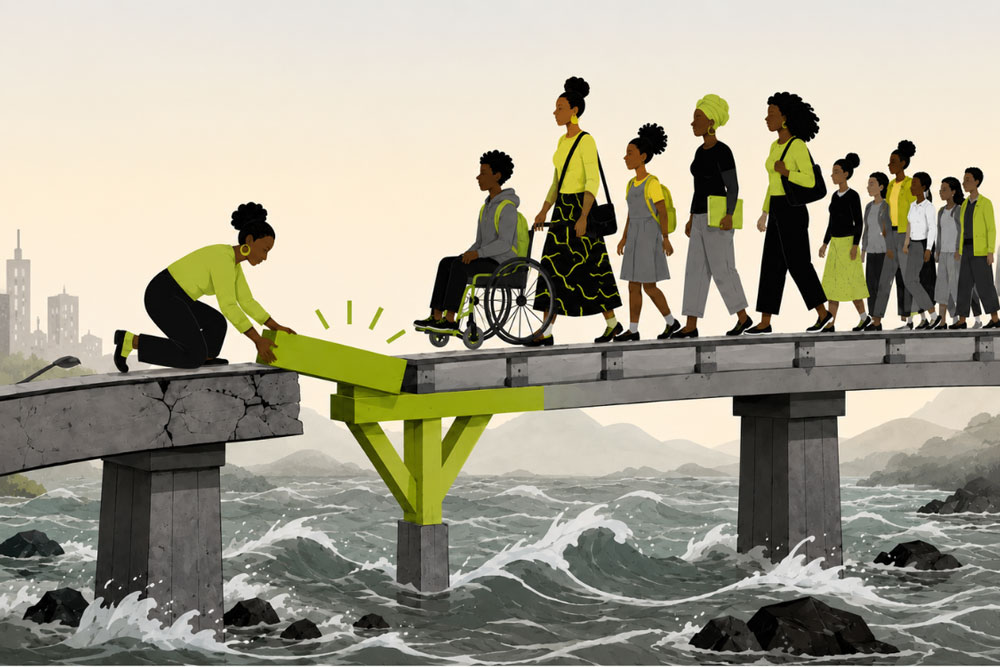
Economies need more than growth stimulus; they need resilience to withstand the disruptions of technology, geopolitics, demographics and climate risk. Resilience also matters for individuals: among the employed young people tracked across multiple income survey waves over two years, there were notable increases in median earnings experienced for those who could stay in the labour market and transition from one job to another – up to a 19.6% increase over 6 months. This points to the value of retaining employment and building work experience over time.
One key to building resilience in youth is implementing labour market strategies that explicitly address the structural barriers facing women, since many of these are magnified versions of those faced more broadly by the most economically excluded. This is similar to the ‘curb-cut effect’, where the design of a system to facilitate access by one group with specific barriers – for instance, curb cuts that enable wheelchair users’ mobility – ends up increasing accessibility for many more people: parents with strollers, the elderly with walkers, delivery workers, tourists with luggage, and so on.
Examples of this curb-cut effect can be found in policy, where, for instance, ECD subsidies can expand access to early learning, improve workforce participation and stimulate new job creation. It can also be seen in urban planning and infrastructure, where street lighting that makes it safer for women to work outside the home also reduces road accidents through improved visibility.
Technology offers significant opportunities to include curb-cut effects in the design of systems. The SA Youth platform is an example of this, where inclusive design targets barriers like spatial exclusion, transport and data costs, and lack of paid work experience, all of which affect women strongly but also impede many young men. Network tools like the SA Youth CV are designed to capture and optimise even the most informal work experience, such as unpaid sibling care or community volunteering. In doing so, the tool helps young people of all genders to build a stronger profile showing more of what they can do.
The GBS sector is a powerful example of how women’s inclusion can be built into the design of growth initiatives. Since 2018, the sector has created 153,574 jobs, with 90% going to young people and 64% to women. This hasn’t happened by chance. It is the result of sustained efforts by institutions like BPESA to embed inclusion into sector growth strategies rather than treating it as a standalone objective. Ecosystem convenors such as sector bodies are positioned to set industry-wide standards and spread practices that translate inclusion from aspiration into practice. Their role demonstrates how intermediary institutions can influence industry norms, making formal labour market opportunities more accessible to groups who have historically been excluded.
Individual employers can also look to create curb-cut effects in their own hiring and employment practices. For instance, while flexible work schedules may specifically enable a parent to work who couldn’t have otherwise, they can also benefit others. The same is true of transport support and work-readiness interventions: while designed to address exclusion, their benefits extend far beyond the people they target. Impact sourcing in the GBS sector has enabled young people from historically excluded communities to access formal work, build skills, and improve financial security. But employers benefitted too: impact-sourced employees recorded monthly attrition rates of just 2.1%, compared with 7% among other hires, and were 42% more cost-effective while delivering comparable or stronger productivity outcomes. This is the curb-cut effect in practice: interventions designed to remove barriers for excluded workers ultimately create value for businesses too, strengthening workforce stability, talent pipelines, and long-term growth.
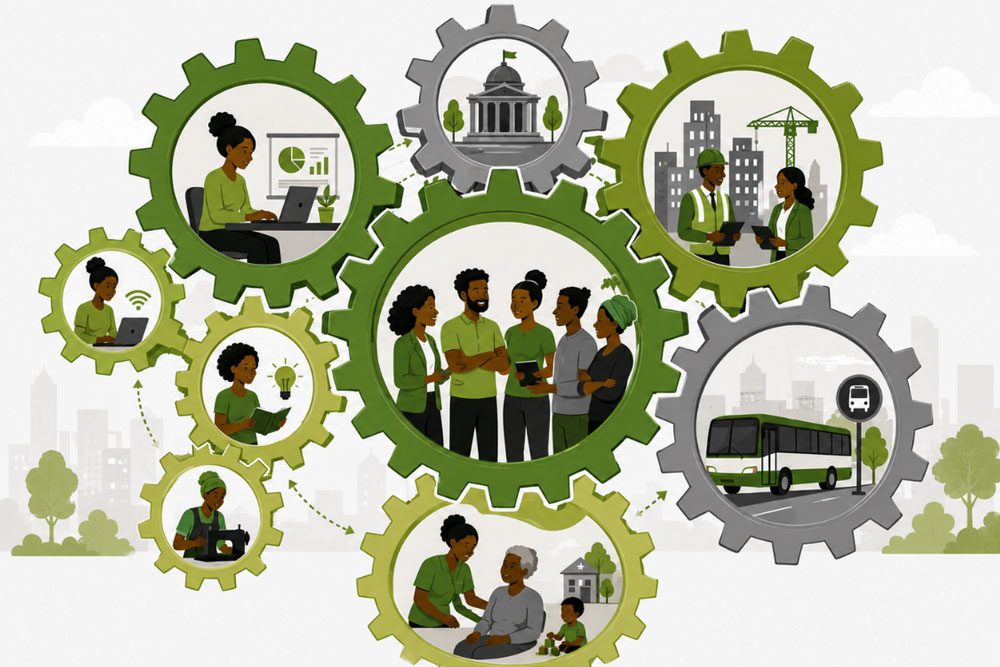
A single curb-cut change in policy or design can have a powerful impact, but women’s ability to find and sustain work over the long term is determined by an interconnecting web of factors. Seeing and coordinating across these is vital to breaking the barriers they face. The GBS sector is often held up as a blueprint for how coordinated ecosystem action can drive both growth and inclusion: women dominate new employment in the sector, which expanded by 421% between 2015 and 2023. This is compared with just 23% growth across the broader Financial and Business Services sector.
The sector’s success suggests that rapid job creation and greater gender inclusion need not be competing goals. With the right mix of industry collaboration, targeted talent development and inclusive hiring practices, they can reinforce one another. The success of the GBS sector plan has stoked the fire around similar plans for other high-growth industries, including Digital through the Digital Economy Master Plan Version 2 and Tourism through the Tourism Growth Partnership Plan.
Sector coordination is important, but not the only form of coordination required. Cross-cutting systemic issues like safety, high costs, misaligned incentives and administrative barriers also require an ecosystem-wide approach. Transportation is one such issue. Transport costs remain a major barrier to work-seeking: data from Harambee’s income survey shows that they account for roughly 20% of median earnings across all employment types. To address this, Uber Rides for Jobs provides interview transport for young work-seekers, improving their ability to access and compete for job opportunities. Since June 2025, 790 vouchers have been distributed and used by work-seekers to help cover the cost of an Uber to job interviews, enabling 1,421 trips. This has resulted in improved pitch rates, a transport cost saving of over R184,000 across participants and 32% eventually securing the role after the interview. With women making up almost 3 in every 4 successful hires, the initiative simultaneously addresses safety concerns and demonstrates how ecosystem partnerships can remove practical barriers to make access to jobs more equitable for all.
Another major ecosystem effort, the Working on Infrastructure pilot, is aimed at aligning public resources, service delivery needs, and pathway infrastructure around a shared outcome: improving young people’s access to sustainable livelihoods. Bringing together the Department of Public Works and Infrastructure (DPWI), the Expanded Public Works Programme (EPWP) and SA Youth, the initiative aims to equip 2,000 young people with installation, repair and maintenance skills so they may earn a living from maintaining infrastructure in their communities. As part of the EPWP Reform Agenda, the pilot explores how public employment programmes can be redesigned to create clearer progression pathways for young people into work.
Many interconnected barriers operate to inhibit self-employment as a viable path in South Africa. This needs to change if we are to absorb more young people into the workforce. Ecosystem coordination is vital in order to unlock a targeted one million sustainable youth self-employment opportunities by 2030. Recent research shows that here, the largest barrier is not lack of training programmes or even access to them: it is unsupported transition into earning. Young people, particularly young women, are interested in self-employment but struggle to move from interest to action to sustainable livelihoods. Overcoming this requires addressing a web of inhibitors both behavioural (e.g. stigma, fear of scams, social skills) and structural (e.g. onerous license and registration requirements, models that pair upfront investment with delayed earnings). Women are active in sectors such as informal retail but face extra barriers related to capital, support networks, safety and access to markets. Ecosystem coordination in the self-employment space means recognising the interactions between these factors and addressing them collectively.
Nowhere is the ecosystem coordination effect more potent than in the care economy. In South Africa, the organisation of care is economically inefficient and socially unjust. It is undervalued and there are shortages across health, ECD, education and social work, which are projected to grow significantly by 2030. Investment in care is a powerful strategy for advancing women’s economic empowerment and economic modelling shows that even modest interventions to formalise and compensate care work could generate huge benefits. For example, employing just 5% of the current workforce gap and compensating 5% of unpaid care workers could contribute R56.25 billion to GDP by 2030, while simultaneously reducing unemployment. These data support a view of care work not as a burden to be minimised, but a catalyst for inclusive growth.
Promising new models hold insights for how we might go about this: Bogotá’s Care Blocks, now being adapted in Freetown, Sierra Leone, reveal the multiplier effect of investing in care. By bringing together childcare, health, training and support services in a central hub that is within easy reach of communities; caregivers gain time, skills and opportunities to participate more fully in the economy. The result is not only greater agency for women, but stronger local economies, more resilient communities and a practical demonstration that care infrastructure can unlock benefits far beyond care itself.
Women are still behind men in the employment stakes, trailing them in access, earnings, and stability. This is a missed opportunity, because when women advance in the labour market, everyone gains – potentially increasing global GDP by 20%. It is also significant for what it tells us about the health of our labour markets. Women’s employment levels serve as vital bellwethers for broad economic opportunity, with the ability to signal structural health and expanded market resilience through rising labour participation and high household reinvestment rates. When female economic inclusion rises, it acts as a leading indicator of overall national productivity and inclusive growth.
Proven strategies exist to drive women’s inclusion, many of which have the potential to create a wider impact via the ‘curb cut’ effect. Several of these strategies can be embraced by individual companies and put into practice immediately and unilaterally, to great effect. The most powerful strategy, though, is ecosystem coordination: the intentional creation of plans and systems that fuel growth while mending broken pathways into employment. The data carry a message from South Africa’s young women: that when ecosystems work, they will too – and when they work, everyone benefits.
South Africa’s official unemployment rate rose by 0.9 percentage points to 33.6% in Q2 2026, with a slight decrease of 16,000 jobs recorded. Overall, employment figures did not move too substantially.
The decline was concentrated in the formal sector, which shed 41,000 jobs between Q1 and Q2. Losses were driven primarily by Community and social services (-57,000), alongside contractions in Mining (-26,000), Agriculture (-15,000) and Manufacturing (-15,000). However, amidst these results there have been positive offsets, with employment gains recorded in Trade (70,000), Construction (39,000) and Finance (11,000). It is particularly encouraging to see the uptick in trade jobs as this reflects a rebound in retail employment following the Q1 decline. The broader informal sector (including Agriculture) also reflected an increase of 34,000 jobs, bringing the total employed in this sector to 3.6 million.
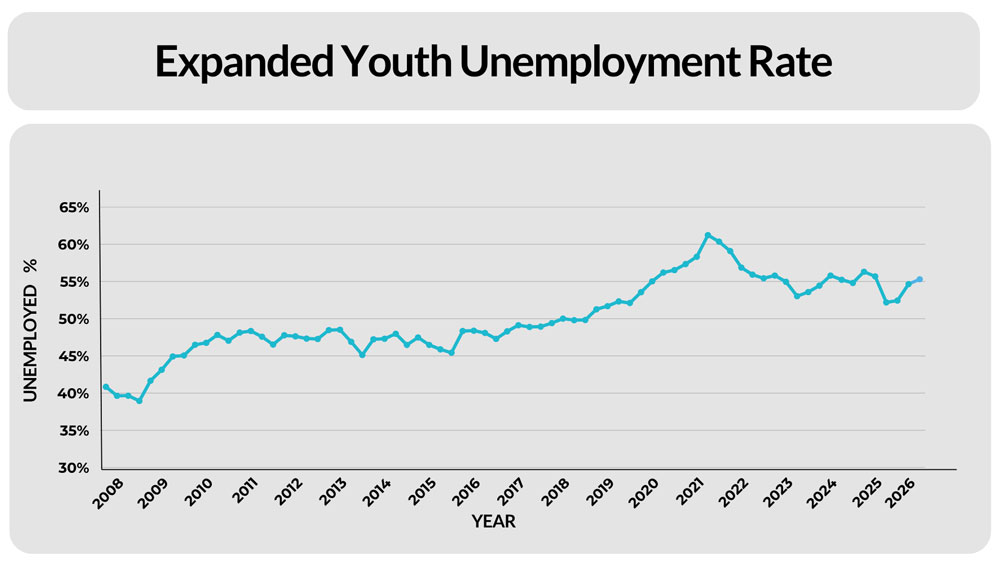
Youth continue to bear the brunt of labour market fluctuations – suggesting that they too offer clues as to where the system is broken. Employment for those aged 18-35 years decreased by 40,000, pushing the expanded youth unemployment rate to 55.3%. The largest losses were in Private Households, potentially reflecting tighter household spending, and both formal and informal employment also showed small decreases. Both men and women felt proportionately similar losses.
Not all sectors followed the downward trend. Retail added 70,000 youth jobs and Construction also recorded gains, suggesting renewed growth in two important entry points for youth in the labour market. Perhaps most strikingly, youth optimism remains resilient: despite youth employment remaining near historical lows, 260,000 more young people have been actively looking for work in the last quarter, while the number of discouraged work-seekers (i.e. those who have given up looking for work) declined by 130,000. Consistent with the small change in employment, the number of NEET youth stayed constant at 9.3 million.





Harambee in the News
01 Jun 2026
Harambee in the News: A snapshot of where Harambee Youth Employment Accelerator was featured in the media each month, reflecting ongoing conversations around youth employment, inclusive hiring, and the partnerships helping to connect young people to meaningful work opportunities across South Africa.
Harambee in the News
18 Feb 2025

Harambee in the News
21 Nov 2024
 Stay Connected